Monday, 7 February 2011

Stubbing out smoking

When the Spanish government introduced a nationwide ban on smoking last month, it transformed the country’s smoke-filled tapas bars and restaurants in to some of the strictest smoke-free zones in Europe.

Just as in the U.K., where a similar ban was introduced in 2007, gone are the days of the old walking stick-clutching men sitting in a bar with a cigarette and a small beer, passing their days chatting to any stranger that will listen to them.

It is automatically assumed that businesses will suffer due to punters not being able to smoke on their premises. However, there is a major cultural difference between Britain and Spain that needs to be considered when discussing the impact of the smoking ban on businesses.

It may be the case that businesses have closed due to the ban in Britain because of the reserved nature of its people; it is not uncommon for Brits to stock up on alcohol from the supermarket on a Saturday night and drink and eat a takeaway in front of I’m a Celebrity or X Factor.
However, Spaniards rarely socialise at home and would much prefer to go out. It is not uncommon for close, life-long friends in Spain to have never been to each others’ houses. They, in their continental style, meet friends outside of the home in cafes, bars or, in the summer, even in the street. Their entire social life is based around the atmosphere that establishments provide rather than the products they serve, unlike in Britain where people are fussy about their alcohol.

Of course, Spaniards love smoking just as much as British people and there’s no doubt that there are a lot of very angry black-lunged Spaniards. However, I believe it will not have the same impact on bars and restaurants as it has in Britain because of this culture and different style of socialising.

When talking to Spaniards about the new law it appears, just as in Britain, that there is a split between those that agree and disagree with it. Many of those who oppose it, be they smokers or non-smokers, refer to the law as being like a product of dictatorship, something Spain knows plenty about. Having only been a democracy for just over 35 years after the four decade-long dictatorship of General Francisco Franco, many Spaniards rebel against anything they see as totalitarian and they see a ban on smoking as being just that.

They also take up the opinion that it is especially damaging to introduce such a law in the middle of an economic crisis because of which bars are closing anyway. But as supermarkets continue to cash in on the closure of drinking establishments in Britain by selling cheap booze and cigarettes, it appears to me that Spaniards lack the entrepreneurial skills to take the same advantage. There are no shops that sell both tobacco and alcohol together in Spain and Spaniards would not be able to find gaps in the market to make money from as they would in other nations.
However, one sector that is cashing in on the smoking ban is patio heater manufacturers. Just as in Britain, bars are now buying these expensive products to keep smokers warm whilst they puff away outside their premises. Walking around my town, there are brand new heaters still in plastic wrapping waiting to be used. At least some Spaniards have business minds.

Time will tell whether the Spanish government will persist in their bid to irradiate smoking from public places, as some establishments continue to flout the ban. It will also be interesting to see if there is a cultural shift in Spain because of the law, and whether Spaniards begin to open up their homes to friends so that they can smoke and drink out of cold nights.

PHOTO: Gordon Jolly

Sunday, 12 December 2010

Losing their religion

During the recent visit of Pope Benedict XVI to Spain, the leader of the Catholic Church took the opportunity to echo comments made about the U.K earlier this year, warning Spaniards about their “aggressive anti-clericalism.”

The Holy Father compared modern sentiments in the country towards the Church to those of the 1930s, when Republican anti-clericalists murdered priests and burned churches during the Spanish Civil War. This of a nation which, just 35 years ago, was under a fascist regime very close to the Catholic Church and which is still considered by many foreigners as being one of the most religious in Europe.

So how ‘anti-clerical’ really is Spain?

It became the first European nation to legalise same-sex marriage when the Cortes Generales, the country’s parliament, passed a law in June 2005. Furthermore, just this year, abortion became fully legal in the country, having only been available in restricted form since 1985. For a land still considered by outsiders as being very Catholic, these measures send out the opposite message.

However, in a 2005 poll, 59 per cent of Spaniards still said that “they believe there is a God” and traditional religious festivals are as popular as ever, with ayuntamientos (town halls) investing huge sums of money in to their local annual fiestas. Small Spanish towns are still built around their magnificent churches and, unlike in the U.K., towns are completely closed on a Sunday. Even the country’s biggest and richest supermarkets are not permitted to open on the day of rest.

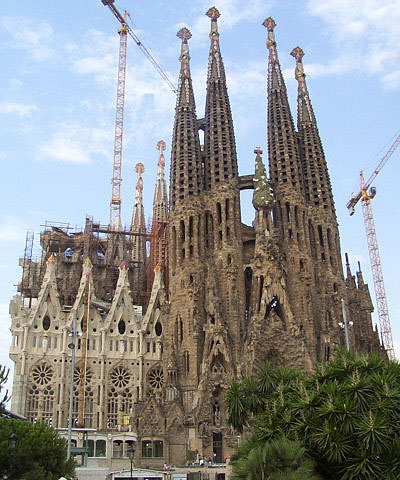
But it is true that there is an underlying resentment towards the Catholic Church in Spain. The day after the Pope consecrated Barcelona’s unfinished church, Antoni Gaudi’s Sagrada Familia, I was surprised to read in the opinion pages of local Aragonese newspapers very similar sentiments to those expressed by many during the Pope’s visit to the U.K. in September.

Spaniards were asking the same questions as many Brits. ‘Why should the taxpayer fund the Vatican’s trip?’ ‘What has the Pope got to do with my life?’ And they too were concerned about Ratzinger’s handling of the child abuse scandal.

In the town where I work in Aragon, the local Church struggles so much to attract parishioners that the priest has been known to pay Romanian boys one euro each to help him out with Sunday mass. From what I can see, the Church has failed to cease the opportunity to attract young people to its pews by offering much needed activities in an otherwise boring area. But the Church has refused to do so.

It is very common in Spain for young people to move to the big cities when they reach 18, leaving their towns of birth and church congregations full of grey hair and walking sticks. The common feelings I sense from young Spaniards is that Church is for old people and a thing of the past - similar to their opinions on bullfighting. Interestingly, many are the children of a generation born under Franco, Spain’s fascist dictator who reinvigorated the influence of the Church in Spain after taking power in 1939. Their parents grew up in a new democracy that had escaped the grasp of the Catholic Church. Will this latest generation even baptize their children in the future?

Spain is now a multi-cultural and multi-faith nation (the first Mosque to be built in Granada for more than 500 years opened its doors in 2003). Only time will tell if the Church finds a way to reengage with the young generations in order to survive. For if it doesn’t, the only remnants of a colourful history of the Catholic Church in Spain could be those stunning places of worship that tower above every town, serving as a reminder of the role the Catholicism once played in the lives of their inhabitants.


PHOTOS:
Benedict XVI in 2006. Papa

Barcelona's unfinished church, la Sagrada Familia. Montrealais

Monday, 25 October 2010

On the menu this week: Ham, Ham, Ham, Ham

As a nation that relies on the lucrative tourism industry, Spain has used its ancient traditions to create attractive images of the country and to pull in holiday makers.

But most Spanish bars and restaurants don’t have Sangria or paella on the menu, and San Miguel is not a popular beer in the non-tourist areas of the country.

I touched down in Spain with the idea that her culinary (and many other) traditions were fading; that’s to say that a diet of Jamón Serrano, Tortilla de Patatas and paella was an image created by clever PR campaigns to attract tourists. This is the same image that has allowed the La Tasca chain of restaurants to cash-in on the tapas trend in recent years.

One well-known symbol of Spain which does continue to play an enormous part in its culture is its famous dry-cured ham, Jamón serrano. Literally translated ‘Mountain ham,’ this delicacy can be found at the top of every bar’s food menu, can be seen hanging from butcher’s windows around town and has an entire isle dedicated to it in my local supermarket.


Bigas Luna’s 1992 film Jamón, Jamón (Ham, Ham) starring a 16-year-old Penélope Cruz (right), was set in this region of Aragón, on the Monegros desert where I work in a school. The characters’ obsession with ham and bullfighting are comical in the film; the male protagonist becomes aroused by joints of meat and defeating bulls. This, I assumed, was an exaggeration of the love Spaniards have for their Jamón.

But during the recent fiestas del Pilar in Zaragoza, I saw men walking around the streets of the city with enormous joints of ham cradled in their arms and a sharp knife in their hands, slicing some off to satisfy the hunger of those around them as they made their way through the traditional annual parade in typical Aragonese costumes.

And it is not just the older generations with this unimaginable addiction to this salted meat; the younger generation are just as obsessed with it and continue Spain’s devotion to its ham. During my first weeks working in a Spanish school, I had to introduce myself to and take questions from 19 classes of 12 to 18-year-olds.

I stand in front of the classes, nervous about what they’re going to ask me having never been in a Spanish school before. I can see the reluctance in their faces, some having questions on their minds for the foreigner at the front but being too nervous to ask them. And then I get it. In a thick Spanish accent I’m asked: “Do you like the Spanish ham?”
Joints of Spanish ham hanging in a butchers. PHOTO: Hunda

Without exception, the first query I got from every group was not asking where I was from, what I was doing in their class or how old I was but whether I liked their dried meat. I could see the frustration on the faces of the younger students with a basic level of English as they struggled to ask me this important question in my language. There were twelve and thirteen-year-olds faced with what could have been the first Británico they have met and this is the first thing they want to know about them.

When I reply that I am fond of a slice or two on a salad I am their new best friend and we can get down to learning some English. I have since been asked this same question by the same classes over and over again. It seems that the students seek some type of reassurance of my acceptance of their culture and traditions; they need to know that they can trust this stranger that only speaks English to them by making sure he is living the Spanish life, understands it and isn’t trying to change it.

The boys are the ones with a real, old-fashioned love for their ham bocadillos. There are competitions between them to see who can bring the best sandwich to school and they guard it between classes, making sure no one steals it. In classes in the morning and early afternoon the radiators in the classrooms are littered with long sandwiches wrapped in tin foil. One student tells me that not only does the radiator keep the bread warm but it makes sure that the ham is still soft for when they get stuck in to their snack at break time. This is a long way from children queuing up for the tuck shop at lunch for a packet of Monster Munch and a cheap sugary drink with a red straw; this is serious stuff.

Life always seems a lot simpler in the more remote areas of Spain and even though a lot of the children come from poor families, their sole concern is how hot the radiator gets so that their sandwich is soft for break time.

Monday, 18 October 2010

It's not just the paella that's heated

Spaniards are not known for their reserved nature or their ability to keep their thoughts locked up.

Some of the country’s mainstream television channels hold fiery daytime debates about hot topics in the headlines and participants sure don’t hold any punches in making their feelings known.

For a Brit used to Question Time on a Thursday night, it can be difficult to understand these hectic, unorganised and anarchic shows. Whereas the BBC has a relaxed panel of media-trained politicians churning out pre-written speeches, a carefully arranged studio and a white haired, experienced television presenter calming down the audience, these Spanish shows are made up of numerous individuals dispersed around the studio; some stand, others sit on stools and others read newspapers. They interrupt, shout over each other and stamp their feet when they hear something they object to. At the same time, bustling bars have these programs on full volume as punters, beer in hand, try their best to get their views heard over those of the featured guests.

In fact, I’ve discovered that if a Spaniard has an opinion on something, and they usually have one about everything, they’ll tell you (which is great when you’re writing a blog on Spain). Ask a countryman here about politics, religion or history, and you should expect a tirade against somebody or something. As a Spanish student, I had seen and heard some evidence of this concept on television and radio before coming to this country.

Travelling home after a long day at work I decide to test this theory on a car full of colleagues. I ask about the local agricultural towns that house the pupils of the secondary school we work in and then listen in amazement as my three compañeros pick apart each other’s arguments about the ‘non-cultured’ peoples of the local farming towns for the entire forty minute journey back in to town. They clash over what type of image of the area they should be portraying to me, a foreigner who is still making their mind up about a new home.

I struggle to keep up with the pace of the conversation and I’m unsure whether I’ve encouraged a good debate to pass the time of the journey or whether I’ve provoked a genuine argument that has become between colleagues; with the tone of their voices it is difficult to tell. I have since come to understand that this is a normal conversation between friends in Spain. I catch “no, you listen to me ‘boy’” before another debate begins.

One colleague tells me about the local area of Huesca. She describes the scenery and the ancient history of the Moors defending their land from the Christians approaching from the nearby Pyrenees Mountains. She appears to be proud of what she has to tell me. But another, younger teacher has no qualms about telling his older counterpart that she is totally wrong about the idea that everyone in the area is proud of its history.

“We have a cathedral, we live in a fantastic place but nobody cares,” he says. “We don’t even care about our families anymore.” This is certainly not an image of Spain I had had in my head before coming.

View of Huesca from the City's cathedral. PHOTO: Murcianboy

We pull up outside my apartment and my colleagues quieten down and say goodbye for the day. I could see them continue their debate, fingers pointed, as they pull away. I had only wanted to know about the areas my students came from and instead had started a long debate between locals which, for the majority, I couldn’t understand.

This was my first day at work and my first week living in Huesca. I would soon come to realise that my combined commute of ninety minutes to and from work would feature regular lively debates between my outspoken work colleagues. I’ve already become used to the Spaniards’ way of talking to each other during discussions; I’ve had no choice but to get used to it living with two Spanish students.